
COMMUNICATION AND TRANSPORT
a) RAILWAY:
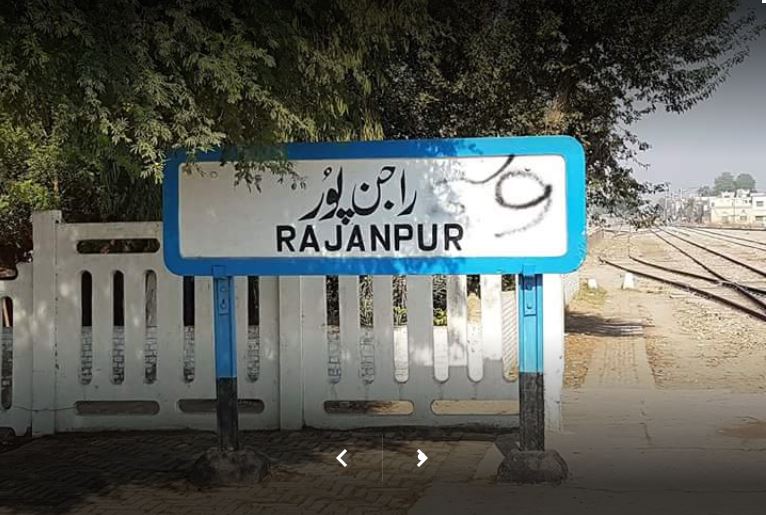
Rajanpur railway station was opened for traffic on 22.04.1973 and Railway traffic started between Kot Adu, Rajanpur and Kashmore section. Previously, this area was not connected by Rail with the rest of the country. The main Railway Stations on this section are Jampur, Muhammad, Fazilpur, Rajanpur, Mithan Kot, Kot Bahram, Rojhan, Wali Mazari and Shahwali.
Total length of Railway Track which passes through the district is about 180 kilometers. Presentably, one Express train i.e. Chilten Express and passenger Train are playing on this route. These Goods Trains carry wheat, fuel wood and other daily consumer goods from the important Railway Stations of the District.
Goods train is an effective means of transporting bulk of surplus goods from Rajanpur District to other parts of the country. This section connects the Rajanpur district on the north with Dera Ghazi Khan, Kot Adu and Multan Section and on the East and South East with Kashmore, Jaccobabad, Larkana and Quetta Section. This track has constantly been threatened by Hill Torrent and so far maintenance has proved it strong enough to with stand Hill Torrent and rain waters in the area. With the passage of time people of Rajanpur District would be provided with better facilities of travel and transportation of goods after connecting Dera Ghazi Khan, Kashmore Section with the main railway line of the country.
b) ROADS:
This District is served by 305.36 Kilometers metalled and 225.60 Kilometers unmetalled rods. Out of which, 244.80 Kilometers of metalled roads are maintained by the Highway Department. The main metalled road emanates from Dera Ghazi Khan passing through the important towns of Rajanpur, upto Kashmore and on the Jaccobabad. Presently Pacca Roads are single but recently the Punjab Government has approved its re-conditioning and widening.
Zilla Council, Rajanpur, is maintaining 152.00 Kilometers mettalled road and 304 Kilometers of Kacha Roads.
There was only one B & R Sub Division at Dera Ghazi Khan before 1947 under the administrative control of Executive Engineer B & R Division Multan. The Sub Divisional Officer Dera Ghazi Khan was entrusted with all construction and maintenance works of B & R in Dera Ghazi Khan District including the present Rajanpur District. A new B & R Sub Division at Dera Ghazi Khan with one B & R Sub Division at Rajanpur was set of in 1951. This department was bifurcated into Buildings and Highways Department in 1967 and a new Highway Division was opened at Dera Ghazi Khan in 1968 and the Sub Division at Rajanpur was named as Highway Sub Division Rajanpur. On creation of Rajanpur as a new District on 01.07.1982, a new Highway Division has been opened at Rajanpur with its Highway Sub Division at Jampur and Rajanpur. A machinery maintenance Sub Division has also been shifted to Rajanpur w.e.f. 01.12.1982. In 1947, there was only one Kacha Road from Mana Bangla to Mithan Kot, under the charge of XEN B& R Department in the present Rajanpur District.
Road communication plays a vital role in the socioeconomic uplift of an area as civilization travels through roads. Road length in a country is usually taken as a barometer of its development. According to the planning commission, the minimum coverage should be 1 – 10 mile per square mile of the area to meet withstand sustain the transport requirements of development efforts. In Pakistan, we are still far behind in this object and the present mileage is hardly 0.2 mile per square mile. This looks in significant when compared with 2.0 miles per square mile for England and 3.0 mile per square mile for France.
In Rajanpur District the Punjab Highway Department is maintaining about 305.86 Kilometers of metalled road which depicts an increase of 152.87% over the figure inherited at the time of independence. However, this increase is less as compared to overall increase of 266% in the entire province since independence.
c) China Pakistan Economic Corridor (CPEC)
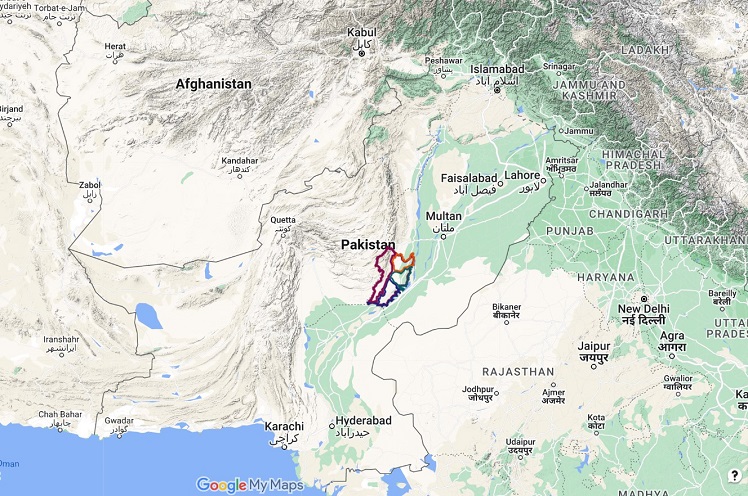
CPEC can be accessed via Kot Mithan and Benazir Bridge from Zahir Peer Interchange.
Drive your Directions:
d) TELECOMMUNICATION:
At the time of partition in 1947, the District of Rajanpur although being a Tehsil had no facility of Telephone and it remained devoid up to May 31-1970. In present District Rajanpur, the Telephone Department was established in June, 1970 with a capacity of an extension Board of 50 Lines. It increased in 1975 to 100 lines and it was extended again in 1979 upto 200 lines.
With the establishment of the telephone system in the District the pace of development increased rapidly. Without this facility merchants had to go to different parts of the country in person. They had to spend a large amount of money and a lot of time by doing so. Now they can telephone whenever and wherever they want. The pace of economic development has increased to a large extent due to this facility.
At present this facility is provided by modern telecommunication companies as the Mobile Devices have taken place of landline telephone. There are many telecommunication companies working in the district at the moment. Their services are also available in the remote areas of the district as well.
e) POSTAL SERVICE IN THE DISTRICT
At the time of creation of Pakistan in 1947, only six combined Sub Officers and ten Branch Offices were working in the existing District Rajanpur. The mail arrangement for branch offices which were situated on the mail line were delivered by the extra departmental runners employed for this purpose. The mail arrangement of all the offices was with the Government Transport Service. The telegraph line was available which was connected with Dera Ghazi Khan and Sukhar passing through the existing District.
Now there are eight sub offices and thirty one Branches of Post Offices Serving the public in this District. The mails are delivered by Railway Passenger Trains on the mail lines to the sub offices and Branch Offices situated on the Railway Line. For other urban and rural areas, in Branch Offices, a Branch Master is responsible for the delivery of mails. In rural Areas where post office is not situated mails are being delivered through village postman and they are authorized to sell all postal (stationery), book registered articles.
Now there are various Private Courier Companies which are providing their services to the public in the best possible way such as TCS, LCS, OCS etc.